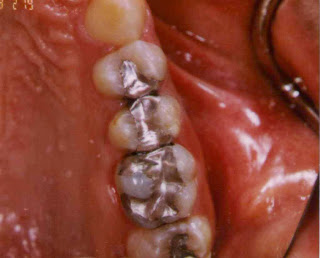
Mercury Banned in Pesticides but not our teeth?
The
toxic effects of mercury depend on its chemical form and the route of
exposure. Methylmercury is the most toxic form. It affects the immune
system, alters genetic and enzyme systems, and damages the nervous
system, including coordination and the senses of touch, taste, and
sight. Methylmercury is particularly damaging to developing embryos,
which are five to ten times more sensitive than adults. (
reference)
Exposure to methylmercury is usually by ingestion, and it
is absorbed more readily and excreted more slowly than other forms of
mercury. Elemental mercury, Hg(0), the form released from broken
thermometers, causes tremors, gingivitis, and excitability when vapors
are inhaled over a long period of time.
Although it is less toxic
than methylmercury, elemental mercury may be found in higher
concentrations in environments such as gold mine sites, where it has
been used to extract gold. If elemental mercury is ingested, it is
absorbed relatively slowly and may pass through the digestive system
without causing damage. Ingestion of other common forms of mercury, such
as the salt HgCl
2, which damages the gastrointestinal tract and causes kidney failure, is unlikely from environmental sources.
Wild
life mortality of seed-eating birds and birds of prey caused by seed
dressed with Hg compounds, alerted the Swedes and Finns in the
1960's
about the risks of using Hg and also initiated studies revealing
alarmingly high Hg content in fish caught close to paper and
chlor-alkali industries. Acquired knowledge about environmental
transformations of inorganic Hg to far more toxic organic forms along
initially largely unknown transfer pathways focused the attention on the
large quantities of Hg used in paper and chlor-alkali plants. Swedish
authorities were first to act and enforced legislation on the use of Hg
in Sweden, to avoid a tragedy such as that in
Minamata, Japan. Consequently, seed dressing with methyl-Hg was prohibited in 1966, and Hg was banned from all pesticides in
1988.
Methylmercury
is produced by methanogenic (TK) bacteria (that produce methane), some
of the oldest living cells known, says Tom Clarkson, a toxicologist at
the University of Rochester. When mercury is methylated through
ingestion by microorganisms, a carbon atom is added on to the mercury
atom. This additional atom is what changes mercury's properties,
allowing it to be readily accumulated in fish. Once released from
microorganisms, methylmercury rapidly diffuses, binding to proteins in living creatures.